
7 Mistakes Businesses Make When Planning a New Factory Building
Introduction
Every factory starts with a plan. Most project problems start with gaps in that plan that nobody noticed until construction was already underway.
Planning mistakes in industrial construction are expensive in a specific way. Unlike residential construction where a bad decision costs a few lakhs, a factory planning error can delay your production launch by months, push your total project cost well above budget, or produce a building that restricts your operations the day you move in.
The seven mistakes below appear consistently across industrial projects in South India. Each one is preventable. Each one costs significantly more to fix during construction than it would have cost to address at the planning stage.
For businesses evaluating pre-engineered steel buildings in Coimbatore and across Tamil Nadu, these are the planning decisions that separate projects that finish well from those that do not.
Mistake 1: Choosing the Building Before Choosing the Site
This is the most common sequence error in factory planning.
A business owner decides they want a 20,000 square foot warehouse. They select a structure size, get a rough cost, and only then start looking for land. When they find a plot, they discover it is irregularly shaped, has a gradient across the surface, has poor soil bearing capacity, or sits in a flood-prone zone. The structure they planned does not fit or costs significantly more to build on that specific site.
The correct sequence is the reverse. Site selection comes first. Site investigation follows. Structure planning happens last with full knowledge of what the ground, the shape, the drainage, and the access road situation actually look like.
Site conditions directly drive foundation cost, which is one of the largest variable elements in an industrial building project. A site with good soil bearing capacity on a level plot can use standard isolated column footings. A poor soil site requires raft foundations or pile systems that add weeks to the construction timeline and lakhs to the civil cost.
Finalise your site, get a soil investigation report, and then start your structure design with all inputs known.
Mistake 2: Underestimating the Eave Height Requirement
Eave height is the clear internal height from floor level to the underside of the roof structure at the building perimeter. It sounds like a secondary specification. It is actually one of the most consequential decisions in the entire building design.
Getting eave height wrong in one specific direction creates a building that cannot do what the business needs. An eave height that is 2 metres too low prevents future installation of racking systems, overhead cranes, ventilation equipment, or mezzanine floors. These additions require height that the building simply does not have.
The cost of correcting eave height after a building is designed and fabricated is not a simple adjustment. It requires redesign of primary frame members, new column sections, and potentially foundation modifications. Done at design stage, adding 2 metres of eave height adds modest cost. Done after fabrication has begun, it derails the project entirely.
The planning discipline required is to specify eave height based on your maximum foreseeable operational need rather than your current minimum. Consider the tallest equipment or racking you might ever install. Add overhead crane clearance if any crane provision is remotely possible in the future. Then add a safety margin.
A building that is slightly taller than you currently need costs modestly more. A building that is 2 metres shorter than you eventually need is a permanent operational constraint.
Mistake 3: Not Accounting for Future Expansion
A factory is not a static asset. The business it serves grows, diversifies, adds product lines, increases throughput, and eventually needs more space.
The mistake is building exactly what is needed today with no consideration for what will be needed in five years. When expansion becomes necessary, the building that was built to its maximum boundary on the plot cannot grow outward. The structural system that was not designed with future column extension provisions cannot grow upward. The electrical and utility infrastructure that was sized for current load cannot support additional equipment without expensive upgrades.
Expansion provisions cost almost nothing when they are designed in from the beginning. A structural frame designed to accept future column extensions adds minimal steel tonnage. End wall framing designed as removable bays rather than permanent walls allows the building footprint to extend later without demolishing existing structure. Electrical main distribution panels sized for 1.5 times current load instead of current load exactly allows future equipment to be added without replacing the main switchgear.
These provisions are engineering decisions made at design stage. They add marginal cost at that point. They save enormous cost when expansion actually happens.
Mistake 4: Treating Civil and Structural Work as Independent Scopes
In most industrial construction projects, civil foundation work and structural steel work are contracted separately. One contractor handles foundations. Another handles the steel structure. When these two scopes are not coordinated through a single point of responsibility, the interface between them becomes a project risk.
The most common manifestation of this risk is anchor bolt misalignment. The civil contractor casts anchor bolts into the foundation concrete based on their interpretation of the layout drawing. The structural contractor arrives with fabricated columns that have base plates with bolt hole patterns that do not match the installed anchor bolts.
Correcting anchor bolt misalignment after concrete has cured requires core drilling, chemical anchors, and delays that add cost from both idle crane time and crew standby charges.
The underlying cause is always coordination failure, not incompetence. When both scopes are managed through a single contractor who takes responsibility for both interfaces, this problem does not arise. When they are independently contracted to separate parties without a shared coordination mechanism, it appears on projects regularly.
Pre-engineered steel building contractors in Coimbatore who manage the full scope from design through civil coordination to erection eliminate this interface risk from the project.
Mistake 5: Ignoring Monsoon and Drainage in Site Layout Planning
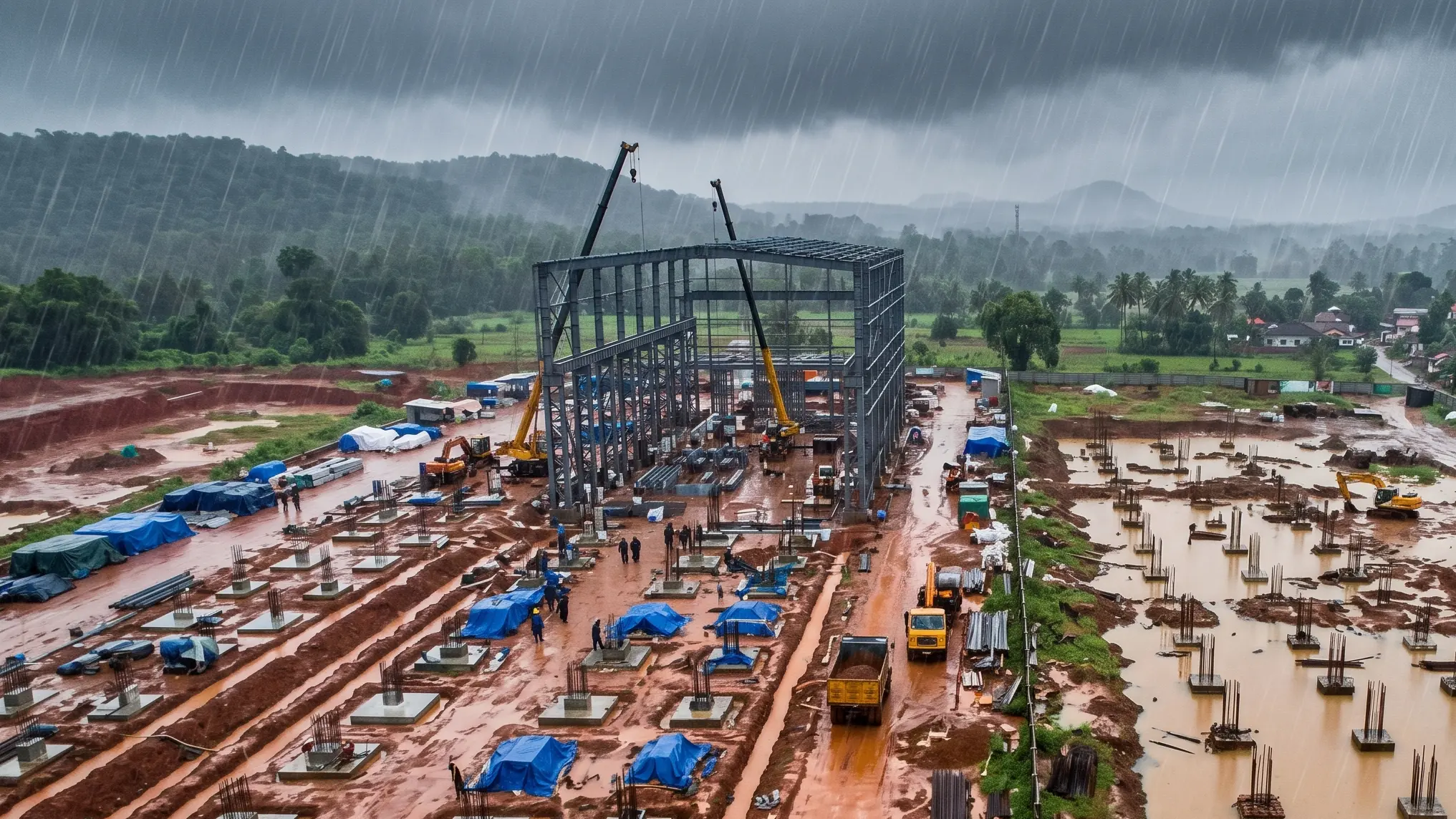
South India’s monsoon season is not a background consideration for construction site planning. It is an active project variable that affects site drainage, foundation construction timing, erection scheduling, and long-term building performance.
The planning mistake takes two forms.
The first is not planning site drainage before construction begins. A factory site with inadequate drainage slopes holds rainwater around column foundations during construction, slows curing, and creates persistent water ingress problems around column bases after the building is occupied. Correcting drainage after construction is complete is extremely difficult and expensive.
The second is not scheduling erection windows to avoid peak monsoon months where the project timeline permits. Erection during peak monsoon in Tamil Nadu between June and September adds 15 to 25 percent to erection duration from working day reduction and crane operation restrictions during rain. Projects that can schedule erection completion before June or commencement after October avoid this duration penalty entirely.
Both considerations cost nothing to address at planning stage. Both are expensive to deal with reactively once the project is in execution.
Mistake 6: Specifying the Wrong Structural System for the Actual Use
Not every industrial building is a warehouse. Not every warehouse has the same operational requirements. Applying a standard structural specification to a building that has non-standard requirements produces a structure that technically stands but functionally underperforms.
The most frequent mismatch is span width versus actual operational need. A business that will use forklifts with 5-metre turning radius in a building specified as a 15-metre clear span creates a layout constraint that affects every day of operation. The building is structurally sound. The operation inside it is compromised.
The second most frequent mismatch is floor load capacity against actual equipment weight. Standard PEB floor slab specifications handle typical warehouse live loads. Heavy manufacturing equipment, loaded storage racking systems, and vehicle maintenance facilities each impose floor loads that require specific slab thickness and reinforcement designs. A standard slab under heavy equipment cracks. Repairing or replacing an in-situ concrete slab under active operations is one of the most disruptive and expensive corrective actions in industrial facilities.
The structural specification must be derived from the actual operational requirements of the building, not from a generic industrial building standard. This requires the building owner to brief the structural engineer completely on what will happen inside the building before the design begins.
Mistake 7: Starting Construction Without a Fully Locked Design
Design changes during construction are the single largest driver of cost overruns and timeline extensions in industrial building projects across South India.
The pattern is consistent. A business starts construction while some design decisions are still pending. Span width is finalised but crane provisions are still being debated. Mezzanine floor is not confirmed but construction has begun. Door positions are undecided but wall cladding is being ordered.
When pending decisions eventually resolve, they require design changes. Design changes at the fabrication stage require re-fabrication of members already in production. Re-fabrication means delays while original components are scrapped or modified and replacement components are manufactured. Delays mean crane hire costs, crew standby charges, and extended site management overhead.
Every design change that happens after fabrication has begun costs more than it would have cost to make the same change at design stage. In some cases the multiplier is five to ten times the original change cost.
The discipline required is simple to state and difficult to execute: do not begin fabrication until every structural decision is final and signed off by the building owner. Brief changes that surface during fabrication should immediately trigger a cost and timeline impact assessment before the change is approved.
Pentaumec Space Structures uses a structured design sign-off process before fabrication commences on any project to eliminate mid-fabrication change costs for clients across Tamil Nadu, Kerala, and Karnataka.
The Common Thread Across All Seven Mistakes
Every mistake on this list shares one characteristic. It was preventable at the planning stage and expensive to correct during execution.
Factory construction is not forgiving of incomplete planning the way some other project types are. Steel fabrication is not like painting a wall where you simply apply another coat. Once structural members are fabricated to wrong dimensions, they cannot be adjusted economically. Once foundations are cast with incorrect anchor bolt positions, correction requires significant remedial work. Once a building is occupied with operational constraints built into its structure, those constraints become permanent.
The investment in complete planning is modest relative to the total project cost. A thorough site investigation, a complete structural brief, a coordinated civil and structural scope, and a locked design before fabrication commences add weeks to pre-construction time and nothing to construction cost.
They prevent the mistakes that cost months and lakhs during construction and years of operational inefficiency after.
For businesses planning a new factory or warehouse facility, Pentaumec Space Structures provides detailed pre-construction consultation covering site assessment, structural brief development, and scope coordination before any fabrication commitment is made.
Contact us: +91 90475 33833 | info@pentaumec.in | pentaumec.in